
On this page · 9 sections
The short answer: store at least 1 gallon per person per day, and aim for a 2-week supply if you have the space. The gallon a day is the Ready.gov baseline, and the two-week home supply is what the American Red Cross recommends.
For one person that’s 14 gallons for two weeks. For a family of four it’s 56 gallons. Those numbers are bigger than they sound, which is why water is so easy to under-store. It’s common to build a deep food pantry and then point at a single case of bottled water like it covers you. It doesn’t. Let me walk through the math and the storage so you can do it properly.
The Short Answer and the Math
The whole plan comes down to one figure: 1 gallon per person per day. That’s the established Ready.gov baseline for drinking and sanitation. Ready.gov says a normally active person needs about three-quarters of a gallon of fluid a day, so most of that gallon is for drinking and the rest covers cooking and basic hygiene. It is not a generous number. It keeps you functioning, not comfortable.
From there the formula is simple:
1 gallon x number of people x number of days = gallons to store
So a household of three planning for two weeks needs 3 x 14, which is 42 gallons. That’s it. The rest of this guide is about turning that number into actual containers in your house, and about knowing when to plan for more than the baseline.
If you can only hit a 3-day supply right now, do that first. Three days is the absolute floor, the CDC’s minimum, and it covers a short power outage or storm. Then build toward two weeks, which is the target I’d push everyone to reach.
Per-Person Storage Tables
Here is the baseline math laid out so you can find your household. These all use the 1-gallon-per-person-per-day figure, and every number is in gallons.
| People | 3 days | 2 weeks | 30 days |
|---|---|---|---|
| 1 | 3 | 14 | 30 |
| 2 | 6 | 28 | 60 |
| 3 | 9 | 42 | 90 |
| 4 | 12 | 56 | 120 |
| 5 | 15 | 70 | 150 |
Look at the family-of-four, two-week column: 56 gallons. A one-month supply for that family is 120 gallons, which is a lot to fit in a small house. That’s fine. The honest plan for longer durations is a two-week store of water plus a reliable way to refill and filter, which I’ll cover further down.
To put the units in context, since most water shows up at the store in different package sizes:
| Container | Holds | Roughly covers (1 person) |
|---|---|---|
| Case of 24 half-liter bottles | ~3.2 gal | 3 days |
| 1-gallon jug | 1 gal | 1 day |
| 5-gallon water jug | 5 gal | 5 days |
| 7-gallon Reliance Aqua-Tainer | 7 gal | 1 week |
| 3.5-gallon WaterBrick | 3.5 gal | ~3.5 days |
| 55-gallon drum | 55 gal | ~8 weeks |
Drinking vs Hygiene: How the Gallon Splits
The one gallon is not all for drinking. Ready.gov puts a normally active person’s fluid needs at about three-quarters of a gallon a day, from water and other drinks, which leaves roughly a quarter gallon for everything else: cooking, brushing teeth, washing hands, wiping down dishes.
| Use | Per person per day (approx) |
|---|---|
| Drinking (all fluids) | ~0.75 gal |
| Cooking and basic hygiene (hands, teeth, face) | ~0.25 gal |
Two things worth understanding about that split. First, the drinking share is the non-negotiable part. You can skip a shower for two weeks and be unpleasant but fine. You cannot skip drinking. Second, that three-quarters of a gallon assumes a normally active person. Ready.gov says water needs can double in very hot temperatures, which pushes drinking alone past a full gallon a day and squeezes out the hygiene water.
So when you plan, treat the drinking share as the floor that never moves and the rest as the buffer that flexes. If you’re tight on storage, store enough that drinking water is rock solid and accept that hygiene gets lean.
Adjusting for Kids, Heat, Pets, and Medical Needs
The 1-gallon figure is a planning average for a typical adult in a moderate climate. Real households vary, and Ready.gov is clear that several situations call for more. Plan up, not down, when any of these apply.
| Situation | Adjustment |
|---|---|
| Very hot weather | Can double water needs |
| Children | May need more |
| Pregnant or nursing | Store more, needs run higher |
| Sick or feverish | May need more |
| Physical labor or evacuation on foot | Drinking needs climb sharply |
| Pets | Add their own water (see below) |
Heat is the big one. In very hot temperatures, or any summer emergency where the power and air conditioning are out, Ready.gov says water needs can double. If you live somewhere hot, plan for closer to 2 gallons per person per day rather than one.
Kids, pregnancy, and illness all push the number up. A sick person running a fever loses fluid faster, and emergencies don’t wait for flu season to end. Build in margin.
Don’t shave the number to make it fit your shelf. If the realistic figure for your household is higher than one gallon, store higher. Under-storing water to save space is the wrong trade.
How Long Stored Water Lasts and When to Rotate
Water itself doesn’t really expire. It isn’t food. It doesn’t rot. What changes over time is the container and what gets into the water from light, air, or the container itself. Stored water that picks up an off taste or grows a little algae is usually a container-and-light problem, not the water going bad.
Here’s how I think about shelf life by source:
| Stored water type | Practical guidance |
|---|---|
| Commercially bottled water | Most reliable. Use the printed date as a guide, rotate as it passes. |
| Tap water in clean food-grade containers | Replace every 6 months. |
| Water in a container exposed to light | Can grow algae. Keep it dark. |
| Water that smells or looks off | Don’t drink it untreated. Filter and treat or discard. |
Commercially bottled water is the most reliable stored water you can keep. It’s sealed, sanitary, and sized in handy units. If you do nothing else, a few cases of bottled water is a legitimate start.
Tap water you bottle yourself should go in clean, food-grade containers, and both Ready.gov and the CDC say to replace it every 6 months. Store it out of direct light and away from heat. Light is what feeds algae, and a cool dark spot keeps water tasting clean far longer.
If you want the full container-by-container breakdown, including treating tap water for storage, sealing barrels, and which containers last longest, that’s covered in how to store water long-term.
Pets and Gardens
Pets need their own water, and they’re easy to forget. A veterinarian at Texas A&M’s College of Veterinary Medicine puts it this way: dogs under 50 pounds need up to 5 cups a day, bigger dogs 10 cups or more, and a cat about a cup, with more in hot weather and after exercise.
| Animal | Rough daily water |
|---|---|
| Dog under 50 lb | Up to 5 cups (about 1.25 quarts) |
| Dog over 50 lb | 10 cups or more (over half a gallon) |
| Cat | About 1 cup |
| Backyard hens | Plan for them too; they drink more in heat |
A big dog can drink more than half a gallon a day, and two of them can match another person’s drinking needs. Add them to the household total honestly.
Gardens are a different category. You don’t store potable water for a vegetable bed, and you shouldn’t. Garden and livestock watering is exactly where non-potable sources earn their keep. A couple of rain barrels for a small yard can carry your outdoor watering during a dry spell or an outage, which keeps your stored drinking water for drinking. Keep the two systems separate in your head: potable for people and pets, captured rain for plants.
Storing a 2-Week Supply in a Small House
This is where plans tend to stall. Fifty-plus gallons sounds impossible in a small home until you spread it around. You don’t need one giant tank. You need a handful of sensible containers tucked into space you already have.
Here’s how I’d build a two-week supply for a family in a small house, mixing container types:
| Container | Quantity | Gallons | Where it fits |
|---|---|---|---|
| Cases of bottled water | 4 | ~13 | Closet floor, under beds |
| 7-gallon Aqua-Tainer jugs | 4 | 28 | Closet floor, pantry corner, garage |
| 3.5-gallon WaterBrick (stackable) | 4 | 14 | Stack in a closet, they interlock |
That’s about 55 gallons across containers that fit in normal household nooks. A few notes on making it fit:
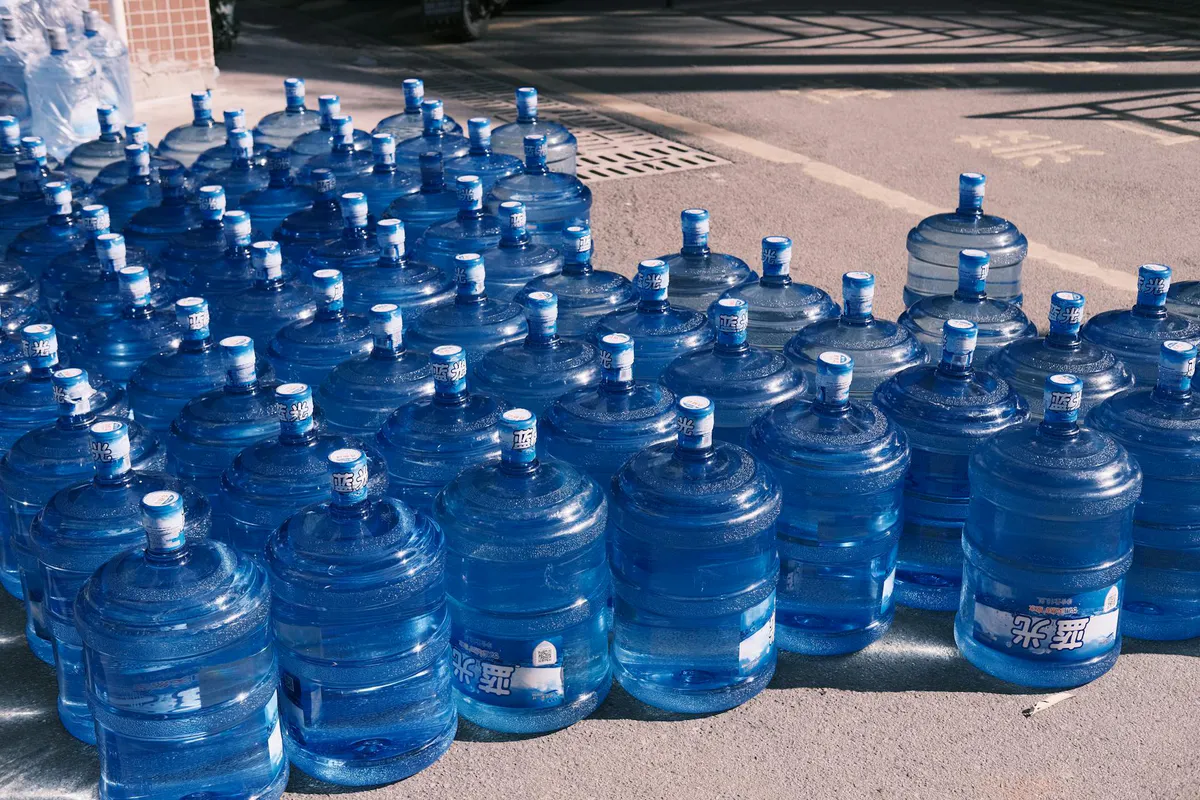
- Big jugs are the workhorse. A rigid 5- or 7-gallon food-grade jug is sturdy, often comes with a spigot, and slides into corners. Most stack only when empty, so give each full jug its own spot on the floor. Water weighs about 8.3 pounds a gallon, so a full 5-gallon jug is over 40 pounds and a full 7-gallon jug is about 58; don’t store them where you can’t safely lift them.
- Stackables use closet height. WaterBrick-style containers interlock and stack like LEGO, so they fill a closet from floor to shelf. They cost more per gallon, so use them where floor space is tight.
- Bottled water fills the gaps. Cases slide under beds and into closet floors. They’re the easiest unit to rotate because you just drink them.
- Skip the 55-gallon drum unless you have garage or basement space. A full drum weighs over 400 pounds and isn’t moving once it’s filled. Great for a garage, wrong for an apartment.
Spread across drinking-water cases, a few big jugs, and some stackables, two weeks of water for a family fits in a small home without much trouble. It just has to be a deliberate choice instead of an afterthought. For more containers and filters, see our picks for water filters and storage.
What NOT to Do
A few mistakes are common with stored water, and they range from gross to genuinely unsafe.
Don’t reuse old milk jugs. This is the classic one. Ready.gov warns that milk protein and fruit sugars can’t be adequately removed from these containers and give bacteria a place to grow. The thin jugs also aren’t built for long storage and tend to split and leak. Don’t do it. Juice bottles have the same problem.
Don’t use non-food-grade containers. Random buckets, old chemical drums, or containers not rated for food and water can leach into your drinking supply. Use containers actually made and labeled for water or food storage. The dedicated water containers (Reliance Aqua-Tainers, WaterBricks, food-grade barrels) exist for exactly this reason.
Don’t store water in direct sunlight. Light grows algae and warm water encourages it. Keep everything dark and cool.
Don’t assume you’ll fill containers when something happens. In a real emergency the tap is often the first thing that fails or turns unsafe: a main break, contamination, a freeze that bursts pipes, or a grid-down event that stops the pumps. By the time you know you need water, the tap may already be dry or unsafe. Store it ahead.
Putting It Together
Store 1 gallon per person per day. Aim for two weeks, which is 14 gallons per person, before you worry about anything longer. Use commercially bottled water for the most reliable supply, store your own tap water in clean food-grade containers and replace it every 6 months, and keep all of it dark and cool. Add water for kids, heat, pregnancy, illness, and pets on top of the baseline, not shaved out of it.
For a small house, spread the supply across bottled-water cases, a few big jugs, and some stackable containers, and it’ll fit. Then pair the store with a way to refill and filter so that a two-week supply can stretch when it has to. Start with three days, build to two weeks, and keep it rotated. That’s the whole thing.