
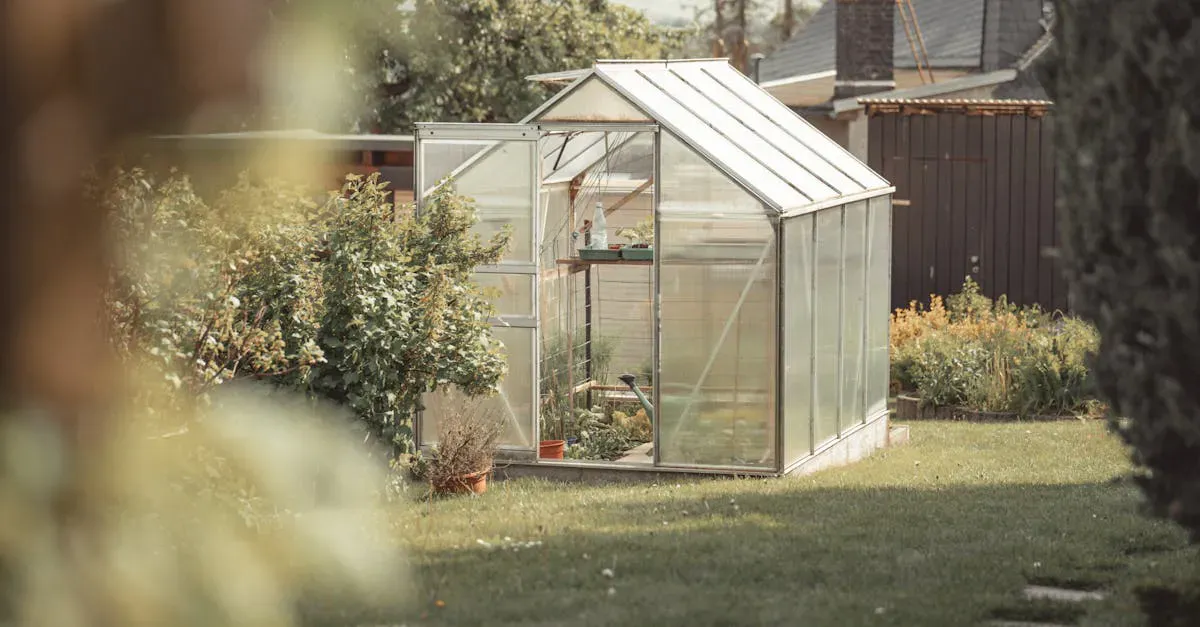
Most small backyards fit a 6x8 twin-wall polycarbonate kit on a level, anchored base. Get a pop-up if you only need a few weeks of cover, a lean-to if your best sun hits the house, or a mini shelf greenhouse for a patio.
Which type fits your yard
Choose the type before the brand. Each one suits a different job.
- Panel kit. A metal frame with twin-wall polycarbonate panels. It holds heat and is built to stay up, but it needs a level, anchored base. See the Mythos 6x8.
- Pop-up. A light steel frame with a plastic cover. It goes up with no base or tools, for a few weeks of cover in spring and fall. See the EAGLE PEAK 8x6.
- Lean-to. It fastens to a sunny house wall, so the wall forms one side. You need a wall you can drill into. See the Sun Room 6x8.
- Mini shelf greenhouse. A few shelves under a zip-up cover. It holds seed trays on a patio or deck, not full-size plants. See the Ohuhu 4-tier.
Glass houses and film hoop houses are not on this list. Glass costs more and needs a solid, level base, per Clemson Extension. A hoop house covers the most ground for the money, but you replace its film every few years.
What size to get
- 6x6: leaves little room once a potting bench goes in.
- 6x8: the usual size for a small yard. It fits a narrow bench on each side with a path down the middle.
- 8x10 or 8x12: more room if your yard has it. Check your town’s permit limit first (see the FAQ below).
The size in the name is the floor on paper. A 6x8 is 48 square feet, but benches and the path take part of it, and the outside is a little bigger. Measure your spot, and leave room to walk around the greenhouse and open the door.
For winter growing
Can you use a small greenhouse in winter? Yes, for hardy greens and sheltered pots, but without heat a small greenhouse gets almost as cold as the outside air by morning, per UNH Extension.
- Pick twin-wall panels. The Mythos’s twin-wall panels hold more night heat than the Hybrid’s clear walls.
- Check the snow rating. Canopia publishes 15.4 lb of snow per square foot for its kits once anchored. The other kits here give none.
- Take a pop-up down before snow. Its cover and light frame are made for spring and fall.
To keep plants above freezing, see how to heat a small greenhouse cheaply in winter.
| Model | Space to allow | What to check |
|---|---|---|
| Mythos 6x8 | 8 ft 1 in x 6 ft 1 in outside, 6 ft 10 in tall. | Level, anchored base; door about 22 in wide. |
| Hybrid 6x10 | 10 ft x 6 ft 1 in outside, 6 ft 10 in tall. | Clear walls hold less night heat; level, anchored base. |
| Outsunny 8x6 | 8 ft x 6 ft 3 in, about 6 ft 5 in tall. | Sheltered spot; the listing gives no wind or snow rating. |
| EAGLE PEAK 8x6 | 8 x 6 ft. | PE cover with no wind or snow rating; take it down before winter storms. |
| Sun Room 6x8 | 8 ft 7 in along the wall x 6 ft 7 in out, 8 ft 1 in tall. | Fastens to a sunny house wall at least 8 ft 1 in tall. |
| Ohuhu 4-tier | 27.2 x 18.9 in, 62.2 in tall. | Seedlings and small pots only; tie it down. |
Palram-Canopia Mythos 6x8 Greenhouse
Pick this for a level, sunny spot about 8 x 10 ft. Canopia rates it for 56 mph wind and 15.4 lb of snow per square foot once anchored. Skip it if your only spot is sloped, or if you need to roll a wheelbarrow through the door. Canopia’s warranty needs a level base and anchors, and its soil anchoring kit is sold separately.
Palram-Canopia Hybrid 6x10 Greenhouse
Pick this for more bench room and brighter light for spring seedlings. It is 10 ft long outside, and Canopia rates it for 56 mph wind and 15.4 lb of snow per square foot once anchored. Skip it if you want to keep plants going through cold nights. Its clear walls hold less heat than the Mythos twin-wall panels.
Outsunny 8x6 Walk-In Polycarbonate Greenhouse
A lower-cost panel kit with about the same floor as the Mythos, for spring to fall growing in a yard sheltered from wind. It costs less, but the Amazon listing gives no wind or snow rating, while Canopia rates the Mythos for 56 mph once anchored. Set it out of the wind and anchor it to a firm base. Skip it if your yard is windy or gets heavy snow.
EAGLE PEAK 8x6 Pop-Up Walk-In Greenhouse
It needs no base and no tools, so it suits renters or anyone who wants cover for a few weeks in spring and fall. One person can set up the steel frame. Skip it if you want a greenhouse that stays up all year: EAGLE PEAK publishes no wind or snow rating, so take it down before winter storms. EAGLE PEAK covers the frame and top for 1 year, against 5 years on the Mythos and Hybrid.
Palram-Canopia Sun Room 6x8 Lean-To
Pick this if your best sun hits a wall of your house; lean-to vs freestanding explains the tradeoffs. Skip it if you rent, cannot fasten to the wall, or the wall is under 8 ft 1 in tall where it would go. Plan the wall fixings and rain runoff before you order. Canopia suggests a concrete or wood deck base, and its manual says to allow at least half a day with two people.
Ohuhu 4-Tier Mini Greenhouse
Pick this for a patio, deck or balcony with no room for a walk-in. Its 4 shelves hold seed trays and small pots, so skip it if you want to grow tomatoes or other tall plants to full size. A tall, light shelf can tip in wind, so tie it to a wall or railing. For more patio options, see the best mini greenhouses.
Before you order
Plan to grow through frost? The heating guide ranks ways to hold heat, from water jugs to a thermostat heater.
Buying the Hybrid 6x10? Get an 8 x 12 ft shade cloth instead, so it covers the longer roof.
Where to put it
Pick the spot with the most winter sun, on ground you can level.
Base and anchors
A greenhouse needs a level, firm base and anchors, or wind can lift it. Canopia lists concrete, treated timber, paver blocks, or soil with an anchoring kit as bases for its kits.
- Gravel pad: drains well and costs little. Gravel will not hold anchors by itself, so set the frame on a timber or paver edge, or run the anchors through into firm soil.
- Pavers or treated timber: a level edge to fix the base to. It works alone or around a gravel floor.
- Concrete slab: the most solid base. Use one if you already have a level pad in the right spot. Pouring one just for a small kit is usually more than it needs.
- Ground anchors: use the maker’s kit where there is one. For the Mythos, Canopia sells a model-specific anchoring kit separately. In sand or loose soil, pick longer augers, around 30 inches.
Wind and snow
A greenhouse catches wind like a sail. Many pop-ups publish no wind rating. Panel kits that do are often rated for 50 to 60 mph, and only when anchored the way the manual says.
- Use a windbreak. A fence, hedge or building on the windy side helps, as long as it does not shade the greenhouse.
- Ask before you add bracing. Check with the maker first, because changes can affect the warranty.
- Close the door in high wind. An open door on the windward side lets wind push up on the roof from inside, as FEMA explains.
Snow: only the three Canopia kits here publish a snow load, 15.4 lb per square foot once anchored. Brush heavy snow off any roof, and take a pop-up down before snow.
Assembly
Plan on two people and a full day for a 6x8 panel kit, plus time to level the base.
- Read the whole manual before you start.
- Check the parts against the parts list, and sort the bolts by size.
- Leave bolts a little loose until each wall is together, so the parts line up, unless the manual says otherwise.
- Fit the weather strips along the panel joints in the order the manual gives.
- Build the frame on its base. Do not move a finished frame into place.