
On this page · 8 sections
A small backyard orchard starts with mature tree size, compatible pollination partners and somewhere to stand while you prune. In the 30 × 40 ft example below, two espalier apples, two freestanding dwarf apples and one compact sour cherry share the space with a clear access path.
Sample Layout: 30x40 Foot Area
Use this example only after measuring 1,200 sq ft of usable planting area. Subtract the house, utilities, easements, required setbacks and other fixed uses first. The edges in the drawing are the edges of that usable area, not necessarily your property lines.
The plan assumes:
- C, D and E each fit a 10 ft mature canopy allowance. Confirm expected height, spread and spacing for the exact variety/rootstock in your climate. A nursery label saying only “dwarf” is insufficient.
- A and B are trained to 8 ft wide and 2 ft deep. These are design allowances that require a suitable tree, support and ongoing pruning. They do not describe the root system.
- A 4 ft path runs down the west edge. It occupies 160 sq ft. Test the gate, turning space and surface with your own cart or mobility equipment; width alone does not make an accessible route.
- The north side is sunny. A trellis here faces the southern sky in a typical U.S. yard. Existing shade, slope and wind can require a different arrangement.
A measured example
Five trees, with room to reach them
30 × 40 ft · 1,200 sq ft · north at the top
Show trunk positions and clearance math
Measure east and south from the northwest corner of the usable planting area. These are trunk centres, not distances between canopy edges.
- A: 8 ft east, 3 ft south. Apple variety A, trained on an 8 ft wide trellis.
- B: 22 ft east, 3 ft south. Compatible apple variety B, trained on an 8 ft wide trellis.
- C: 9 ft east, 18 ft south. Freestanding dwarf apple, variety A.
- D: 21 ft east, 18 ft south. Freestanding dwarf apple, variety B.
- E: 15 ft east, 32 ft south. Compact, self-fertile sour cherry.
C and D are 12 ft apart. Two 10 ft canopies leave a 2 ft gap between them; use the separate 4 ft west path for the main access route. E is about 15.2 ft from C and D, leaving about 5.2 ft between their assumed canopy edges.
The west path uses 4 × 40 = 160 sq ft. C's canopy ends at that path; E's ends 3 ft before the south edge. A and B sit 3 ft inside the north edge, with their planned 2 ft canopy depth leaving 2 ft behind them. This is planning geometry, not a required boundary setback or a trellis construction specification.
Your trees come from a local or mail-order nursery: bare-root in late winter, or potted in fall. These four items cover the rest, from a soil test this fall to trunk guards for the first winter.
Choose the five trees as a set
A and B: two compatible apple varieties for espalier. Choose varieties with overlapping bloom and usable pollen. Repeat those same varieties at C and D, on rootstocks suitable for freestanding trees with the stated size and spacing. This keeps pollination planning manageable. The letters are placeholders, not cultivar names.
E: one compact, self-fertile sour cherry. North Star is a candidate for a suitable climate: University of Minnesota Extension lists it as self-compatible and up to 10 ft tall. Confirm its expected spread locally before assigning it the 10 ft circle. A larger cherry needs a larger plan.
Want pears instead? Replace both C and D with a locally recommended compatible pear pair only if their mature dimensions and required spacing fit. Do not put an isolated pear into this apple plan and assume the apples will pollinate it.
Stake it out before ordering
Mark each trunk with a stake, then mark a 5 ft radius around C, D and E. Walk the main path and every harvest route. Keep supports, irrigation and future growth out of that path. There is only a 2 ft canopy-edge gap between C and D; it is not the cart route. If the chosen trees need wider spacing, reduce the tree count or redraw the area.
If this is part of a larger food garden, reserve the orchard’s future shade before positioning beds or a greenhouse. Our quarter-acre layout separates those uses. For an optional greenhouse, compare actual kit footprints, opening vents and anchoring space after mapping the sunny area left outside the orchard. The drawing does not reserve a greenhouse footprint.
Choosing the Right Trees
For apples, University of Minnesota Extension recommends at least eight hours of growing-season sun. Check summer shade across the whole mature canopy, not just at the young trunk. Avoid sites where water stands after rain.
Test the soil before you plant. Apples grow best at a soil pH of 6 to 7, per the same Minnesota guide, and pH is much easier to adjust before planting than after. Use the mail-in test in the kit above, or your state Extension soil lab. Extension lab results also give a lime rate if the pH is low.
Dwarf Trees
Rootstock controls size, but the fruiting variety and site also matter. Oregon State Extension’s apple rootstock table gives dwarf apple spreads of 5–10 ft and heights of 6–15 ft, depending on the combination. That range is why this plan requires an exact tree specification.
Ask the nursery for five things: the variety, rootstock, local mature spread and height, recommended spacing, and support requirements. M.9 apples need permanent staking, according to the Minnesota apple guide. Plan the support before planting.
Semi-Dwarf Trees
Do not substitute semi-dwarf stock into the circles. Oregon State lists a 15–25 ft spread for several semi-dwarf apple rootstocks. Larger trees may suit a larger yard, but they change the light, pruning access and number of planting positions here.
What to Avoid
Avoid buying before you know the rootstock and pollination requirements. A low price or a tall nursery tree does not tell you whether it fits. For species and climate considerations, continue with fruit trees for small yards and your local Extension recommendations.
Pollination: The Thing Everyone Forgets
Two trees of the same apple variety do not make a dependable pollination pair. Penn State’s orchard pollination guidance explains the need for compatible varieties, overlapping bloom, viable pollen and active pollinating insects. Triploid apples cannot supply useful pollen to a partner; do not choose one as either half of this simple A/B pair.
Keep a short planting record with each tree’s variety and its confirmed partner. Check flowering time, not harvest month. The apple positions here are close together, but distance cannot repair incompatible varieties.
For pears, Penn State recommends planting at least two Asian pear varieties for dependable cross-pollination. Check the exact pairing for European pears too. A sour cherry’s self-fertility should not be generalized to all sweet cherries, plums or other fruit.
Espalier: The Space-Saving Secret
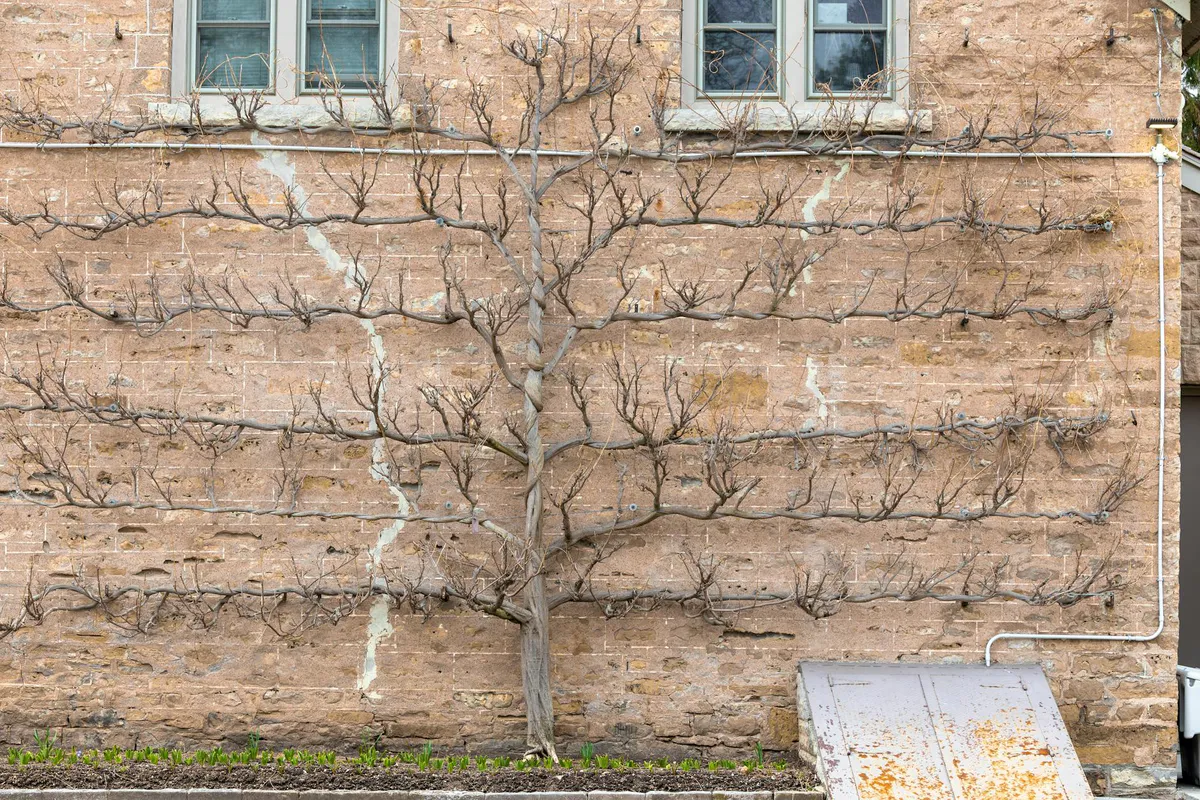
Espalier trains branches across a support instead of into a broad crown. It saves canopy depth but adds regular training work. Oregon State’s espalier guide calls for a strong trellis and pruning several times during the growing season.
In this example, each tree has an 8 ft wide support bay. Its trunk is 3 ft inside the north edge, leaving 2 ft behind the assumed 2 ft deep canopy. Leave access in front for tying, pruning and harvest. If a fence blocks the sun or you cannot maintain both tree and support, choose a freestanding arrangement instead.
Install a trellis designed for the mature tree and local conditions; a decorative fence is not automatically a suitable support. Oregon State’s guide uses posts 8 ft apart with 12-gauge or heavier galvanized wire: the first wire 18 in above the ground, and more wires every 18 in above it. Use the Extension training instructions for the chosen form and adjust ties as branches grow. Expect training to continue over several seasons.
Match the tool to the cut: bypass pruners up to about 5/8 in, loppers up to about 1.5 in, and a pruning saw for anything thicker.
The Fruit Tree Guild Concept
A mixed planting around an orchard can be appealing, but start with the tree’s water, light and maintenance needs. Do not fill the young root zone with a dense companion planting or count on herbs to replace a pest-management plan.
For young apples, Minnesota Extension advises keeping grass and weeds out of a roughly 3 ft radius for the first three to five years. That means a 6 ft diameter clear zone, not 3 ft across. Place any flower border beyond that zone and outside the access path.
Planting and Early Care
Prepare the site first. Check local planting season, drainage and underground services before digging or driving trellis posts. Have the support and water supply ready when the trees arrive. A garden cart can help move mulch and tools, but the plan does not require buying one.
Plant without crowding the roots. The Minnesota stone-fruit guide recommends a hole that accommodates the roots without bending them and cautions against heavily amending only the planting hole. Poor drainage needs a site-level solution, not a pocket of rich compost.
Stake the trees that need it. Ask the nursery which rootstock each tree is on. The Minnesota apple guide says M.9 trees need a stake for life, and M.26 trees usually need one for the first few years. Use a post about as tall as the tree once it is driven 2 ft into the ground. Tie the trunk to it with a wide, soft strap like the one in the kit above, not wire or twine.
Guard the trunks before the first snow. Voles and rabbits chew young bark in winter, and a tree chewed all the way around is essentially lost. For the mesh guards in the kit above:
- Put them on at planting and keep them on through winter, when voles do most of their damage.
- Set each guard 4 to 6 in into the soil and 1 to 2 in out from the trunk, with room for 5 years of growth, per UVM Extension and Iowa State.
- Keep the top above your usual snow depth, since voles tunnel under snow and chew as high as it reaches. If the lowest branches start below the top, trim the guard to stop just under them.
- Pull mulch back from the guard, the same as from the trunk.
- Per the Minnesota guide, the guard can come off once the trunk has rough, flaky mature bark.
A trunk guard does not protect the canopy from deer.
Water for the soil and weather. Check moisture in the root zone and account for rainfall. A fixed number of hose minutes cannot tell you how much water a tree receives. Avoid letting new roots dry out or sit in water.
What to Plan Next
Plant the trees first, then fit the rest of the yard around their mature size.
- Make watering easy to keep up. Young trees need checking through their first dry spells. If the orchard is a long hose-drag from the spigot, a drip line with an emitter at each tree is simpler to run on a timer. Compare drip irrigation kits, which are sized for beds, and add tree emitters if the kit does not include them.
- Put vegetable beds outside the future shade. The eighth-acre garden layout covers sun mapping, bed sizes and paths for the space left over.
- Keep a greenhouse out of the canopy’s path. If you still want one, read where to put a small greenhouse before choosing a site, and check that spot’s sun in fall and winter, not just in summer.
Learn the right pruning system. Apples and cherries need different decisions about branch structure and fruiting wood. Use Oregon State’s home-orchard pruning guide and local advice before making major cuts. It says to prune once the risk of fall and early-winter freezes has passed but before growth starts in spring, which usually means late winter. Include thinning, fallen-fruit cleanup and pest monitoring in the annual workload.
Realistic Yield Timeline
Treat the first seasons as establishment and training. Oregon State’s rootstock table gives three to five years to first bearing for its dwarf apple examples; that is not full production or a guarantee for your site. Frost at bloom, pollination, tree health and management can change the result.
Record bloom, fruit set, pests and harvest for each tree. Add more trees only when the existing ones fit your routine. This layout deliberately makes no pounds-per-year promise: a count of planting positions cannot predict a household’s food supply.