
On this page · 6 sections
Short answer: if you have a small yard and want finished compost with minimal hassle, get a tumbler. If you have more space and generate a lot of yard waste, get a bin. Here’s the full breakdown.

Compost Bins: The Basics
A stationary compost bin sits on the ground and holds material while it breaks down. They range from simple wire mesh circles to enclosed plastic bins with lids and access doors at the bottom.
The cheapest option is a GEOBIN, which is just a roll of perforated plastic that forms a cylinder. It’s a budget pick, and GEOBIN lists it at 70 to 246 gallons depending on how wide you set it.
A common choice is a basic enclosed plastic bin (like the Redmon Green Culture), a mid-range pick. These have a lid on top for adding material and a sliding door at the bottom for scooping out finished compost.
How Bins Work
You add material to the top. Greens (kitchen scraps, fresh grass clippings) and browns (dried leaves, cardboard, straw) go in at roughly a 1:2 ratio. Microorganisms break it down. The finished compost settles to the bottom over time.
You can turn the pile with a pitchfork to speed things up, or you can just let it sit. Turning adds oxygen, which the decomposing organisms need. More oxygen means faster breakdown. It also keeps the pile from becoming a rodent nesting site, which we cover in do compost bins smell or attract rats.
Bin Timeline
These are rough ranges that swing a lot with the mix and the weather.
Without turning: 6 to 12 months or more. NC State Extension says an unturned leaf pile takes about a year. With regular turning (every 1 to 2 weeks): 3 to 6 months. Hot composting method (careful ratio management, frequent turning): NC State describes about a month of active heating followed by four to eight weeks of curing. But hot composting in a bin takes real dedication.
Compost Tumblers: The Basics
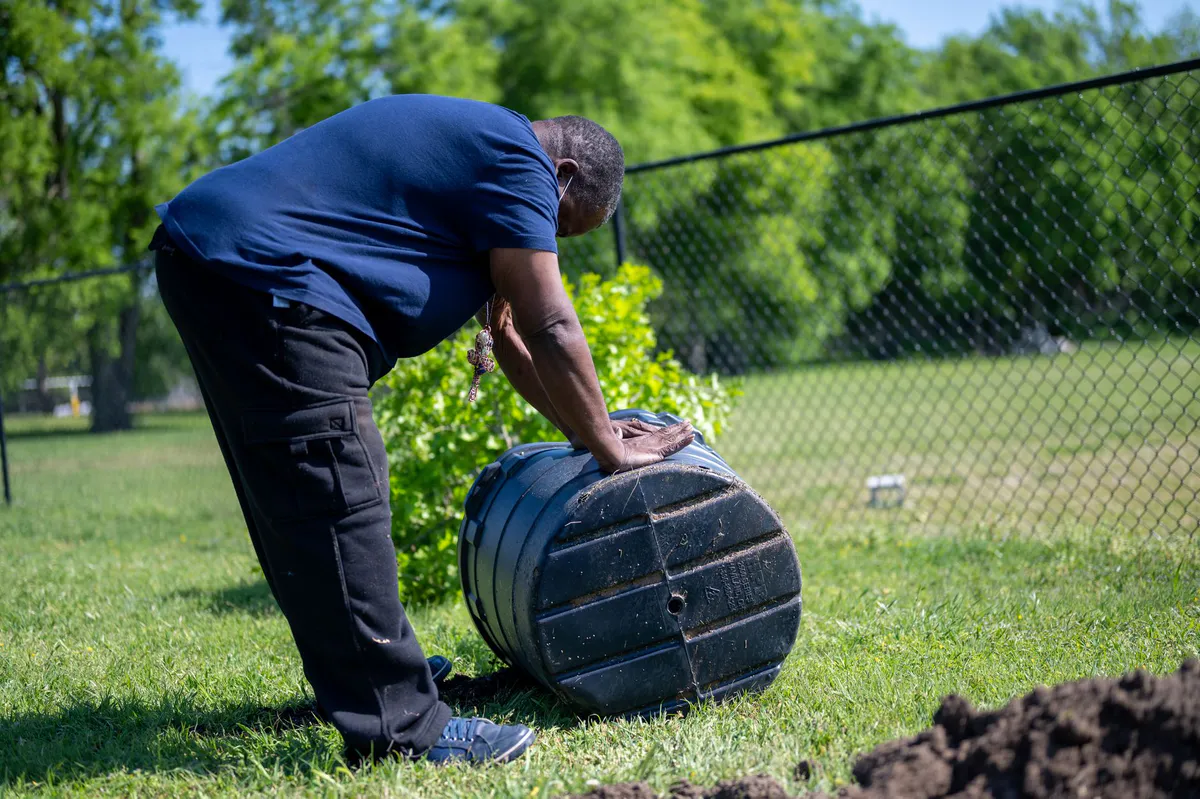
A tumbler is an enclosed barrel mounted on a frame that lets you spin or rotate it. You add material, close it up, and turn the barrel every day or two. The tumbling action mixes and aerates the compost without you needing a pitchfork.
Most tumblers are dual-chamber, meaning one side can be cooking while you add fresh material to the other side. This gives you a continuous supply instead of one batch at a time.
A decent tumbler is a mid-range purchase. The FCMP IM4000 dual-chamber is a common, solid mid-range pick. The Lifetime 60058 is sturdier and sits a bit higher in the mid-range.
How Tumblers Work
Add material (same green/brown ratio), close the lid, and spin it every day or two. The tumbling distributes moisture, mixes ingredients, and adds air. The enclosed design traps heat, which accelerates decomposition.
Tumbler Timeline
With regular spinning, makers quote a few weeks. FCMP says the IM4000 can finish a batch in as little as two weeks in hot, sunny weather, and Envirocycle quotes 4 to 8 weeks for its drum.
Treat those as best cases. An Oregon State University Extension answer calls tumbler composting “a very slow process” in practice, and you have to get the moisture and ratio right. Too wet, and the tumbler becomes an anaerobic swamp that smells terrible. Too dry, and nothing happens. The enclosed space doesn’t self-regulate the way an open pile does.
The Head-to-Head Comparison
Speed
Winner: Tumbler, usually. A well-managed tumbler can finish a batch in weeks in warm weather, while a bin typically takes months. The tumbler’s closed design holds heat and the spinning action keeps oxygen flowing, and both speed up decomposition. Small tumblers lose that edge in cold weather, when they can’t hold their heat.
Capacity
Winner: Bin. A standard enclosed bin holds roughly 65 to 80 gallons, and a GEOBIN opens up to 246 gallons. Popular dual-chamber tumblers like the FCMP IM4000 and the VIVOSUN hold about 43 gallons in total, split between two chambers. If you generate a lot of yard waste, bags of leaves, garden debris, and prunings, a bin handles the volume better.
Cost
Winner: Bin. You can get a functional bin in the budget-to-mid-range zone. A decent tumbler starts in the mid-range and a good one runs higher in the mid-range. Over time, both are cheaper than buying bagged compost.
Ease of Use
Winner: Tumbler. Spinning a barrel takes 10 seconds. Turning a bin with a pitchfork takes 10 minutes and actual effort. For people who won’t realistically stand outside turning a compost pile every week (be honest with yourself), the tumbler is more likely to get used properly.
Pest Resistance
Winner: Tumbler. Tumblers are closed and raised off the ground, so rats, raccoons, and other animals can’t get in as long as the doors close fully. Insects still can. Ground-level bins with open bottoms are accessible to rodents, especially if you’re adding food scraps. If pests are a concern in your neighborhood, this matters a lot.
Odor
Winner: Tumbler. The sealed design contains smells. A well-managed bin shouldn’t smell bad either, but tumblers are more forgiving if you mess up the ratio.
Space Required
Winner: Tumbler (slight edge). A dual-chamber tumbler’s footprint is roughly 2 by 2.5 feet. A bin takes about the same ground space but you also need room to work around it with a pitchfork. Both fit in small yards, but the tumbler is slightly more compact in practice.
Continuous Feeding
Winner: Bin. You can add material to a bin anytime. With a single-chamber tumbler, adding fresh material to an in-progress batch resets the clock. Dual-chamber tumblers solve this (add to one side while the other finishes), but you’re limited by the chamber size.
The Third Option: Just Pile It Up
I have to mention this because it’s what a lot of people actually do, and it works.
Make a pile of leaves, grass clippings, kitchen scraps, and garden waste in a back corner of your yard. Walk away. Come back in 6 to 12 months. You’ll have compost at the bottom of the pile.
No bin. No tumbler. No equipment. Just a pile.
The compost won’t be as uniform or fine as what you get from a tumbler. You might get some weed seeds that survived because the pile didn’t heat up enough. But for mulching garden beds or amending soil, it works perfectly.
This method is best if you have a medium to large yard, don’t care about aesthetics, and aren’t in a hurry for finished compost.
My Recommendation
For most people with small yards who are composting kitchen scraps and small amounts of yard waste: get a dual-chamber tumbler. Here’s why.
You’ll actually use it. The barrier to “composting” drops from “spend 10 minutes turning a pile with a pitchfork” to “spin a barrel while walking past.” That difference sounds small, but it determines whether composting becomes a habit or something you tried once.
Tumblers keep pests out. If you live in a neighborhood with houses close together, keeping rats away from your compost is not optional.
The faster turnaround is motivating. Getting finished compost in weeks instead of months keeps you engaged. Waiting half a year for results makes it easy to give up.
Yes, tumblers cost more upfront. The FCMP IM4000 is a mid-range pick. Every batch you make is compost you don’t have to buy by the bag, which offsets part of that cost over time. We put the top models side by side in our researched picks for compost bins and tumblers if you want to compare specific models.
What If You Want Both?
Running both is the best of both worlds if you have space. The tumbler handles kitchen scraps and produces fast compost for garden beds. The bin handles large volumes of yard waste (fall leaves, garden cleanup, pulled weeds) that would overwhelm the tumbler.
Put the tumbler near the back door for convenience. Put the bin in a back corner of the yard, where it doesn’t matter that it looks like a pile of dirt.