
On this page · 6 sections
Pick up a handful of soil from your yard. Squeeze it. If it forms a tight, sticky ball that holds its shape, you have clay soil. Welcome to the club.
Clay soil is actually nutrient-rich. Plants love the minerals in it. The problem is drainage and structure. Clay particles are microscopic and pack together so tightly that water sits on top instead of draining through. Roots can’t push through the dense layers. Plants drown in spring, bake in summer.
The good news: you don’t have to fix your entire yard. Raised beds solve the clay problem almost entirely. Here’s how.
Two Approaches (and Which One to Pick)
Option 1: Amend the Clay In-Ground
You can work amendments into your existing clay soil to improve its structure. This means adding gypsum, compost, and coarse organic matter, then tilling it all together.
Gypsum (calcium sulfate) is widely sold as a clay fix, but it is not a sure thing. It can improve heavy clay and sodium-rich soils. WSU Extension horticulturist Linda Chalker-Scott also notes that its effects are often short-lived, that most urban yard soils aren’t improved by it, and that you should get a soil test before adding it.
Adding 3 to 4 inches of compost and tilling it into the top 8 inches helps immediately. The organic matter creates air spaces between the clay particles.
This approach works, but it’s slow, labor-intensive, and you need to keep amending year after year. Clay reverts to clay. The structure improvement fades as organic matter breaks down.
Option 2: Build Raised Beds on Top (Do This)
For most backyard gardeners, building raised beds on top of clay is the better path. You’re not fighting the clay. You’re bypassing it entirely.
A 10 to 12 inch tall raised bed filled with good soil gives your plants everything they need. The clay underneath actually helps with one thing: it acts as a natural water table that holds some moisture below the bed, so your raised bed doesn’t dry out as fast as it would sitting on sand.
The only prep you need to do to the clay is rough it up. Use a garden fork to stab holes in the clay surface where your bed will sit. This lets water drain slowly through the clay instead of pooling at the bottom of your raised bed. Don’t till it smooth. Rough and poked is what you want.
On heavy clay, a raised bed gets you to good soil faster than amending the ground.

The Raised Bed Fill Recipe
This mix suits beds built over clay. It drains well, holds moisture without waterlogging, and has enough nutrition to grow almost anything:
- 60% topsoil (screened, not fill dirt)
- 30% compost (aged, finished compost)
- 10% perlite or coarse vermiculite (for drainage and aeration)
For a standard 4x8 raised bed that’s 12 inches deep, you need about 32 cubic feet of fill. That breaks down to:
- 19 cubic feet of topsoil (about 3/4 of a cubic yard from a landscape supply)
- 10 cubic feet of compost
- 3 cubic feet of perlite
Buying this in bags from a garden center adds up fast for each bed. Buying bulk topsoil and compost from a landscape supply company usually costs less per bed. The bulk route is cheaper if you have a pickup truck or can get delivery.
What NOT to Do
Don’t Add Sand to Clay
This is the most common mistake. It makes sense on paper: clay is heavy and dense, sand is loose and drains well, so mixing them should improve drainage. Right?
No. Clay particles are so small that they fill the spaces between sand grains. Instead of getting loose, drainable soil, you get something closer to concrete. It’s actually worse than straight clay.
This isn’t a myth. University of Arkansas Extension says it takes sand at 50% or more of the soil volume, in most cases, to change a clay soil’s texture. With less, the clay acts like glue and the soil gets denser. At that point you’ve basically replaced your soil with sand and lost the nutrients clay provides.
Don’t Use Just Compost
Filling a raised bed with 100% compost sounds great. It’s rich, it’s fluffy, plants love it. The problem is that compost breaks down. A bed filled with pure compost settles as it decomposes, and you can lose several inches of depth within a couple of seasons.
Compost also holds too much water when used alone. It becomes soggy. Root rot becomes a problem.
Compost is an amendment, not a base soil. Mix it with topsoil at that 30% ratio and you get the best of both worlds.
Don’t Skip the Fork Holes
If you just plop a raised bed on top of hard clay without poking any drainage holes, water will pool at the bottom of the bed. The clay acts like a bathtub. Your soil mix drains nicely, but the water has nowhere to go once it hits the clay layer.
Spend five minutes jabbing a garden fork into the clay every 4 to 6 inches across the whole bed footprint. Push the fork in deep (8+ inches) and wiggle it to open up channels. These channels let water slowly percolate through the clay over time.

Building the Beds
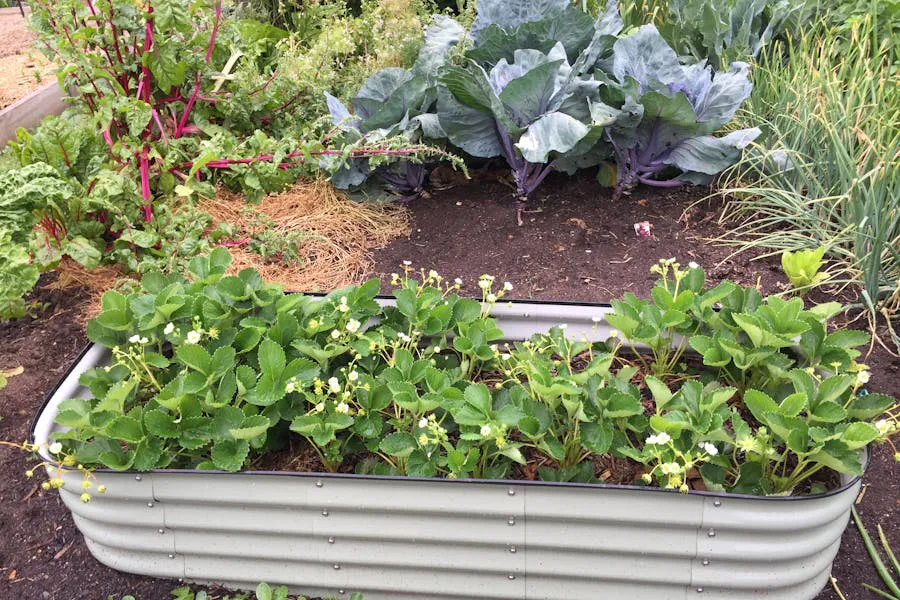
You don’t need fancy raised bed kits, though raised bed kits to skip the clay entirely are a quick option if you’d rather not cut lumber. The simplest DIY option is four boards screwed together. Use untreated cedar, which naturally resists rot, or regular pine lumber, which rots years sooner.
For treated lumber, University of Maryland Extension considers today’s copper-based preservatives low in toxicity (the old arsenic-based CCA type has not been sold for residential use since 2004) and suggests a heavy plastic liner between treated wood and the soil. Coated steel beds are another low-rot option that pairs well with a clay base, and if you’re unsure about them, we cover whether metal raised beds are safe and whether they get too hot.
Bed dimensions that work well:
- Width: 3 to 4 feet. You need to reach the center from either side without stepping in the bed. Wider than 4 feet means compacting the soil with your feet, which defeats the purpose.
- Length: 6 to 8 feet is standard. Longer is fine but costs more.
- Height: 10 to 12 inches minimum over clay. Less than that doesn’t give roots enough good soil above the clay layer. Going higher (18 to 24 inches) is nice for your back but costs more to fill.
For a 4x8 bed that’s 12 inches tall, you need four 2x12 boards (two 8-foot and two 4-foot) and some screws. The cost depends on the wood type.
Year-Over-Year Maintenance
Your raised bed soil will settle and compact over time. Every spring, add 2 to 3 inches of fresh compost on top and gently fork it into the top few inches. Don’t till the entire bed depth. Just work the compost into the top layer.
This does two things: it replaces the organic matter that broke down over the previous season, and it adds nutrients for the new growing year. Running a compost bin to build soil for those beds gives you a free, steady supply of that finished compost instead of buying bags every spring.
Over the years, the clay underneath the bed slowly improves on its own. Earthworms move between the good soil and the clay, creating channels and mixing organic matter down into it. Given time, the bed improves the clay beneath it without extra work from you.
When In-Ground Amendment Makes Sense
There are a few situations where amending clay in-ground is worth it:
- Lawn areas where you want better grass, not beds.
- Tree and shrub planting holes. Amend the backfill when planting.
- Large-scale food production. If you’re growing on a quarter acre or more, raised beds for everything gets expensive. Amending the native soil with compost and cover crops makes more sense at scale.
- You already have okay clay. Some clay soils are clay-loam, with a decent mix of particle sizes already. These respond well to compost amendment without raised beds.
For a backyard vegetable garden on heavy clay, raised beds are usually the better bet.